
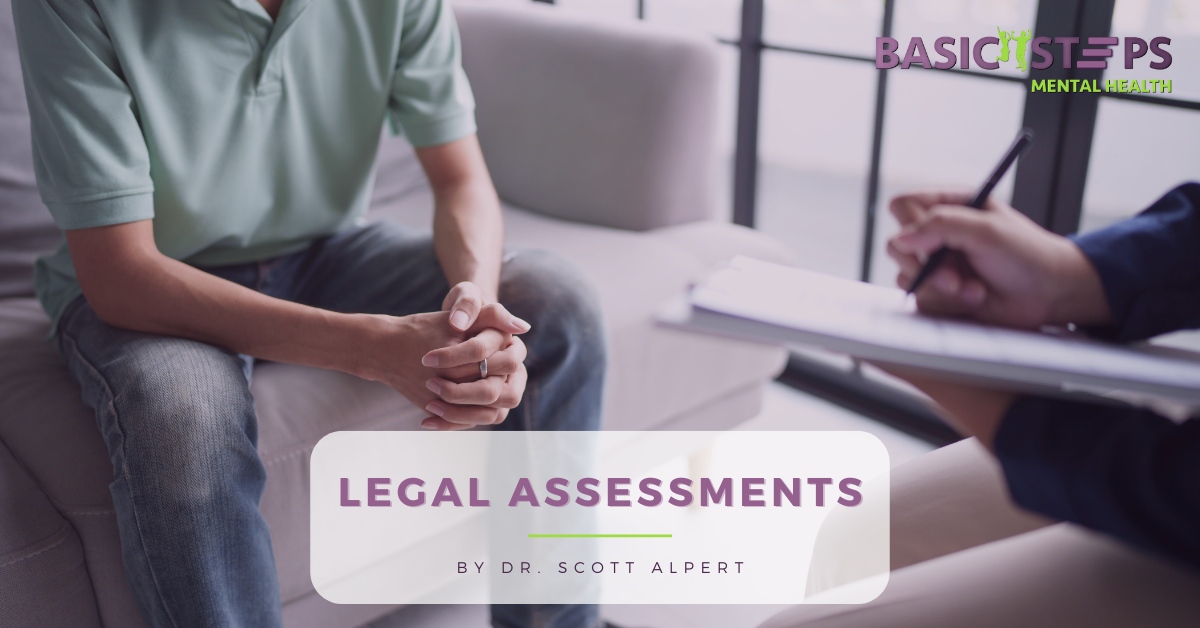
Legal Assessments
In 2017, I opened Basic Steps Mental Health, a clinic that assists people with mental health issues and issues with substance addiction. What we offer are individual sessions, group sessions, family sessions, an intensive outpatient program, and a partial hospitalization program—which is temporarily on hold. It is a big undertaking offering six hours of treatment five days a week, so we have focused on the others mentioned above. And, oh yeah, we also offer legal assessments.
To be honest, legal assessments are not my favorite. I started to offer them to help people who couldn’t afford them. Because our name starts with a “B,” Basic Steps is at the top of the list that Snohomish and King County courts give to people, so more and more of these assessments came my way. Happy, happy—joy, joy.
Look, I have been trained as a therapist and one who goes into the trenches with people. My background is in crisis treatment, and I worked at the first Mental Health Urgent Care Center, where, for eleven years, I treated over 7,000 people. I saw all types, all diagnoses, and the keyword here is “treated.” With legal assessments, it isn’t treatment but an evaluation—or, to say it more clearly—I judge people.
This hasn’t sat well with me. Mother Theresa said, “If you judge people, you don’t have time to love them.” In graduate school, our student body worked on releasing judgments and seeing each person as valuable, having a timeless soul inside, and having all the resources within themselves to heal. Lawyers may be judging right and wrong; therapists try to see the beauty of the person who is seated in front of them. Two worlds are now colliding, and I am in the midst of this.
What does a person who is focused on seeing someone’s inner beauty do? I tried to advocate for the little guy, reduce the cost, and help out people who slipped through the cracks. All that viewpoint got me was lost money, time, and effort. I didn’t factor in that court assessments usually included other court documentation called “collateral information,” including police reports, a criminal history, other testimonies, and long dissertations of testimony that were pages long. I had a practice to run, and these were taking me far from it.
After years of soul-searching, I raised the price. Because of this, people complained. They didn’t factor in that with an assessment, there are also treatment recommendations I provide. Where most facilities recommend months of treatment, I was asking the client to go to a single AA meeting. It wasn’t a good business plan for me—but again, I was trying to help out people who were drowning in court obligations that were setting them back thousands of dollars.
When I discovered other facilities charged $1,500 for this legal service, I was shocked. Now I understand why. I don’t think I have made any money from them, but many administrative companies use them as a real income grabber. True, their assessments are way more professional than mine. I fill out a state form, while theirs look like doctoral dissertations!
If you are looking for a legal assessment, try to decide how professional it needs to be. If there are numerous sources of input—as will be the case with child custody cases—the highly professional one is in order. In those cases, I have had a few tossed out by the court. Now, if it is down and dirty—I am your man.
Here is the issue: in graduate school, you can decide if you want to take the administrative track or the counselor track—I chose the counselor one. I entered this field to assist, not push reports and tests. This is not to say that my assessments are horrible. I actually do produce good reports, using the format given to me by the Department of Health Services. I also write in regular language that most people could understand. And I read my final statement to the client out loud so they can make any adjustments to it… well, within reason.
I believe these legal assessments got on the wrong track. Originally, they were designed for a neutral facility to create and give recommendations for other facilities to fulfill, in order to reduce corruption. Think about it—if your facility did an assessment, they can also recommend themselves to fulfill the six months of residential treatment—bolstering their numbers. Contrast that to my one AA meeting. Yeah, even some of the judges balk at my assessment when they read it. But I stand by them—that is, until I get some new information that contrasts with what the client told me. It is disturbing to be lied to, but I try to remain centered and will add on the appropriate treatment.
I am empathic. I try to place myself in the person’s place. They got popped for a DUI and are now forced to undergo all sorts of punishment. They are placed in jail for a few days, have to be assessed by a psychological professional, need to do community work, go through possible inpatient treatment, leave their job and their loved ones, and are stuck with other people going through the same. I have a few clients who are stuck with me for two to five years, depending on the assessments made on them. If you are a nurse who was caught using on the job, there is the WHPS program, where people need to attend five years of treatment before their license returns to good status—a little more involved than a single AA meeting.
The legal system versus the psychological system. Have you ever seen a lava lamp? Oil and water don’t mix. I try to negotiate through this to the best of my ability, but I am trained to be neutral and not judge. Now I have to deal with people who are judges—kind of ironic.
To conclude, it is important to understand that I also recommend intensive outpatient and residential treatment for people. I handle this professionally, like I did at the crisis center, where I was licensed to place people on 5150 72-hour holds. I knew all the forms to fill out and considered all the options for these people who were either a danger to themselves, a danger to others, or gravely disabled. My legal assessments are thoughtful. If I discover that a person has a serious disorder or substance use issue, I will recommend the proper treatment. I am not here to help people buck the system. I talk to them about my concerns, ask them how they would like to treat this, and most of the time, it is more severe than my own, but I believe that people want to take care of this issue properly so they don’t get into this type of trouble again.
Compassionate Care is Always Available
There are many more tools and strategies you can use in your pursuit of happiness. Here is where we come in. Contact us at Basic Steps Mental Health and let us support and educate you on this journey back to your loving heart center. Imagine living a heart-centered life, regardless of what is happening externally. We’d love to be of help.
For 25 years, Dr. Scott Alpert, the clinical director of Basic Steps Mental Health, has treated over 7,000 people with mental health and addiction problems, using a Psychological approach that mixes and matches ten of the top approaches used in the industry. We are here virtually and in-person to help you get through this COVID-19 pandemic and many other difficulties you may be experiencing.
May you have good mental health.
Related Posts
Nine Life Lessons
Thirty-two years. That’s how long I have been in this industry. It is...