
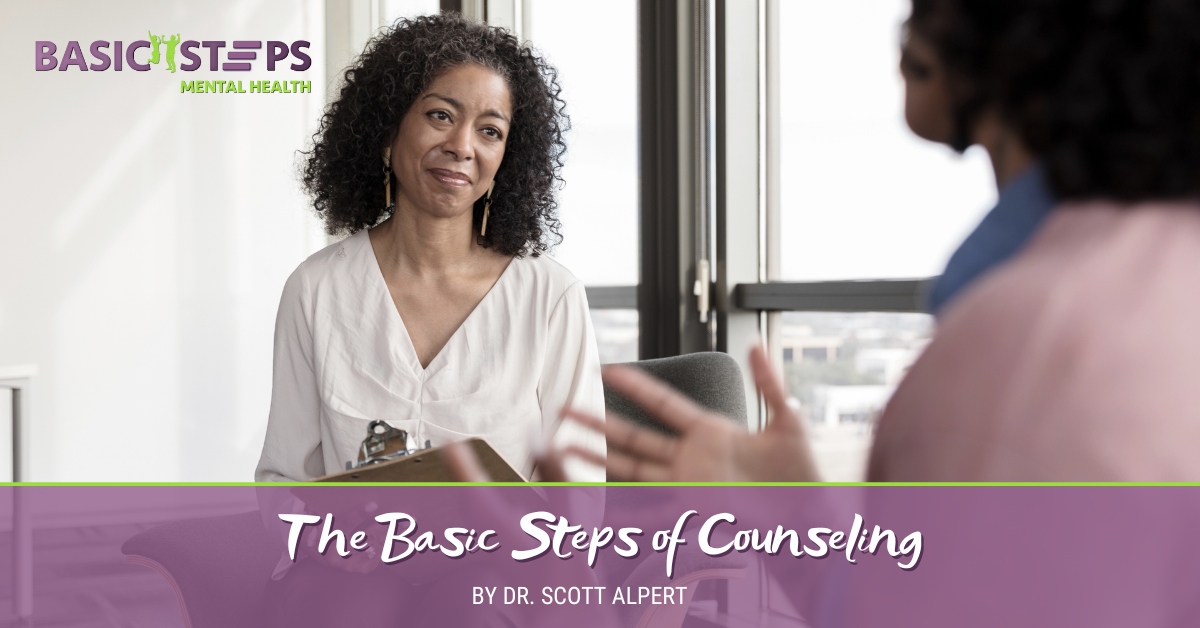
The Basic Steps of Counseling
We have a new intern at Basic Steps Mental Health, and I thought it would be helpful to write out the basic steps of being a therapist for them. Then it dawned on me that writing an article on this would be helpful for anybody interested in the healing arts. For those who do not want to go into the field but suffer from mental health and substance-related problems, this article can also be very useful because our theory on helping people is to teach them the tools professionals use so they can learn how to heal themselves.
For budding therapists, I want to point out that you cannot heal people; you don’t have that power. But you can help others by helping yourself. You see, people learn not by what we say but by what we do. The more balanced you are, the more effective you will be as a counselor. So this article is then focused on ways in which to heal yourself (which at times can actually feel like a full-time job). If you fail to do your inner work, the clients you meet with may share an issue that you also have, and you will get triggered. From that moment, the session becomes damage control on your part.
When clients upset us, we call it “Counter Transference.” This means we are seeing in the other person our wounded self. Many therapists are unaware of this dynamic because it takes place in the subconscious. When triggered, take in a breath, exhale, recenter yourself in your loving heart, and many times I will repeat in my mind, “God bless you, I love you,” as a way to keep myself centered. Once the session is over, make it a priority to process through it in counseling, in supervision, or through your own self-counseling. Overall, the first priority of counselors is learning how to work on the unresolved issues that they have.
Let’s focus on what is the primary tool in counseling, and that is love. Love for yourself, love for the other person, and love for what they went through. Spiritual Psychology is a practice that believes love heals. If you simply sit there and practice heart-centered listening, that alone can help your client learn and grow. Let’s look at it this way: psychology is the science of relationships, and breaking down the word relationship means “relate.” When two or more people are relating, they form a momentary bond. Counselors need to establish a loving bond with a client in order for magic to take place. When they are guarded, don’t trust the person, or have some agenda they are making more important than the client, it will hamper the relationship. Are you task-oriented or person-oriented? People aren’t there to be manipulated but loved. If they want to do something not scheduled in the session, let it be. Go with it. Therapy is not about being in control; it is all about staying present with what is and trying to keep your heart open. It can be the best roller coaster ride of them all!
Since the client is the expert on themselves, counselors need to be good listeners. Remember this: “Listening is loving.” Let the person talk and see how long you can keep them on their subject. “What I heard you say is your father never listened to you. Can you tell me more about that?” This is called “Perception Checking” and “asking open-ended questions.” Make sure you understand them and praise their efforts. For example: “Amazing. What I heard you say is you told your mother you were grateful for her being supportive. Well done!”
There is a lot of information about creating a therapeutic bond with a client. This means that you create a sense of safety between you and the client. According to the textbooks, this takes around 6 months, but it isn’t uncommon for the bond to be instantaneous if you surround yourself in love and kindness.
It is obvious that loving the client is key to providing excellent care. We say that our relationships are a reflection of how we are doing with ourselves. Do you love yourself? Do you think others are more important? If people really knew you at your core, what would they think? If you have poor self-worth, then individual counseling is in order. As you work to release the negativity and the judgments toward yourself, your counseling skills will improve. And no, this isn’t a one-time thing. To help others, you have to constantly work on yourself or risk burnout. And yes, burnout is something real and happens to the best of us. It isn’t uncommon for therapists to care more for others than themselves, and once you become aware of this, shut it down. Take a few days off to be with yourself. Here is the foundation of longevity in the industry.
My key to counseling is to be an expert in your field and stay within the scope of your understanding. We are here to educate people on how they can help themselves. You are not going to be there with them every moment of the day, but they are. We may tell them what works for us, but they need to learn what works for them. So educate, love, and listen.

I am truthful. Many counselors are secretive and have reasons to withhold information from their clients. I myself will share personal information to emphasize a point or give an example. I talk to clients about the abuse I suffered, my substance dependence, being homeless, and other personal matters. I do this to paint a picture that even though I went through all of that, I still was able to heal, grow, and become a better person. Honesty has always been the best policy.
My graduate school had a saying: “The Father does the work.” The more you counsel others, the more you will understand that it has nothing to do with you. If you are entering the field to fix others, you can’t. Then who can? Basically them. Also God. When you sit in front of another person, centered in your loving heart, this is when God speaks through you. Pay attention to your gut, and information will flow in. Then speak from that intuition. If God is love, then the godliest thing we can do is love ourselves and love others. In a sense, the practice of spiritual psychology is like being in active prayer.
The model of healing in Spiritual Psychology is: “When love is applied to hurt, we heal.” Love (God) heals. Therefore, sit back, be present in your loving heart, and listen, then repeat back what you heard them say. To take this to the next step, avoid giving advice; this will foster codependence. Empower your clients. Ask them what their options are, or if they were you, what do you think they would tell you to do? “I think you would tell me to write this out, rip it up, recenter, and try again.” “That sounds like a great idea,” I would respond.
The attitude of a counselor is everything. If you come into a session with a preconceived notion that they are evil, then the session will be a flop. Let go of this and find something about the person you like. Our energy (both good and bad) will be reflected by the client. If you don’t trust them, they won’t trust you. If you can find compassion, then they, too, will find compassion. And this is how therapy works.
I often tell myself that if I went through their life experiences, I too may be exactly how they are. This helps me find compassion for even hardened criminals.
I was walking down the hallway of a 12 Step inpatient facility with my first supervisor. A young man dashed by us, smacked some girl on the back of her head, and ran off laughing. The supervisor asked me what the odds were that the man would be a success in his life. I gave poor odds. My supervisor told me that he doesn’t want to throw out negativity because people pick up on energy. He has trained himself to see people as a success.
You probably had some preconceived notion about an article on how to be a counselor other than this. Though counseling can really be this simple. People just want to be heard. Oftentimes, they haven’t been heard by others, and they haven’t been heard by themselves. Carl Rogers, who developed the Person-Centered approach, stated that when people really hear themselves, they change. They feel more at ease, more confident, and discover who they really are deep down.
I encourage you to study, test yourself, go through your own therapy, attend lectures, go through personal growth seminars, and meet with like-minded people who are also working on themselves. The more work you do on yourself, the more help you can be to others. You may see something differently, as with Narrative Therapy. You may have an “Ah-ha” moment doing Gestalt Empty Chair work. But as long as you continue to improve yourself, well… I don’t need to be a broken record.
The last thing I recommend is called debriefing, especially when you are new in the industry. Make it a priority to talk to a supervisor or a fellow student about sessions and get their feedback. Counseling is an art form, and this art form takes time to get confident with. In the meantime, write things out and rip them up if there is nobody available to talk with. It can be a bit overwhelming at first, battling with your unresolved issues, so be gentle on yourself. Yes, counselors make mistakes. We are not perfect. Often, clients correct me when I say something that is incorrect. I appreciate their input because it helps me grow. Counseling, to me, is two human beings meeting in order to heal and grow. It isn’t focused only on the client, but therapists, too, will heal and grow. That is the magic of being in the healing arts.
Do I have any last tidbits of advice? Bottom line: relax, enjoy yourself, and for counselors, it is not about you. People who enter counseling need to put in the effort, and from this effort, they heal themselves. My teachers used to tell us not to work harder than the client. When I find myself putting in more effort, I stop. Then I ask what is on their mind. I used to sit in silence for 15 to 20 minutes when people had nothing to talk about. Learning how to handle the silence has been a real key. Eventually, people will talk. If not, then the both of you are not a match, and provide them with referrals.
Compassionate Care is Always Available
There are many more tools and strategies you can use in your pursuit of happiness. Here is where we come in. Contact us at Basic Steps Mental Health and let us support and educate you on this journey back to your loving heart center. Imagine living a heart-centered life, regardless of what is happening externally. We’d love to be of help.
For 25 years, Dr. Scott Alpert, the clinical director of Basic Steps Mental Health, has treated over 7,000 people with mental health and addiction problems, using a Psychological approach that mixes and matches ten of the top approaches used in the industry. We are here virtually and in-person to help you get through this COVID-19 pandemic and many other difficulties you may be experiencing.
May you have good mental health.
Related Posts

How to Choose One of Our Programs
Choosing the type of treatment you go through is very important because there are...

Surviving a Crisis
In 2001, the first Mental Health Urgent Care center in the country opened and...