
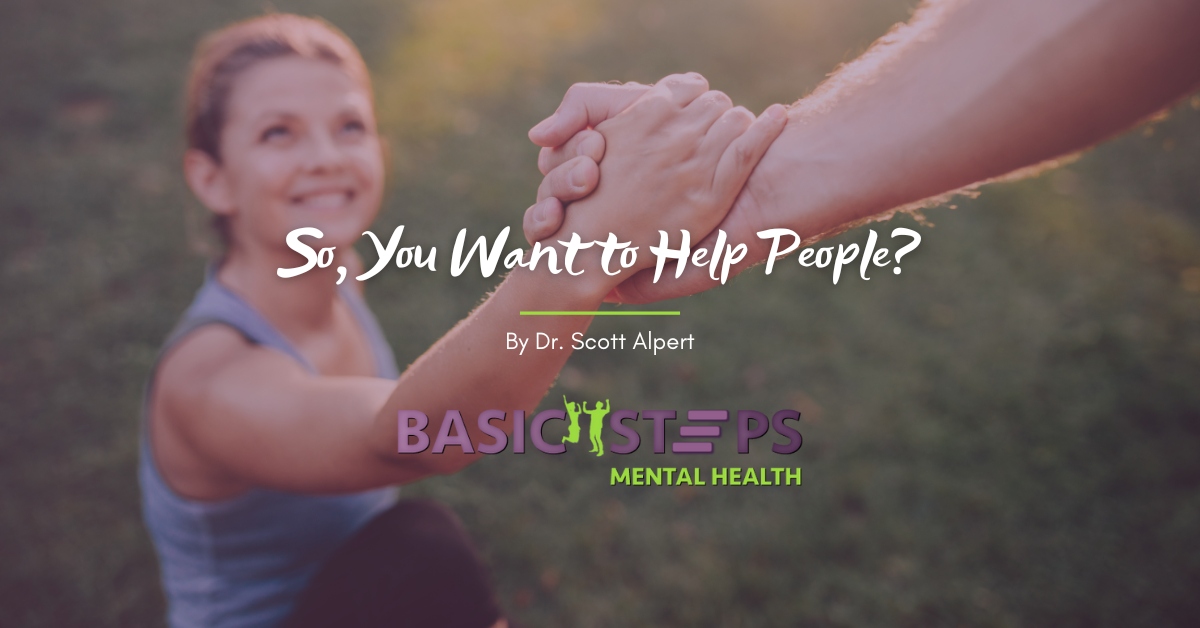
So, You Want to Help People?
I learned, on my first day in graduate school, that I couldn’t fix people. Frustrated, I had to find another strategy to help myself feel better. At that time, emotionally, I felt broken and tried to win the hearts of people so they would not hurt me. You see, I came from years of childhood abuse, and deep down, I tried to protect myself from ever experiencing any type of abuse again. So I tried to play the nice guy, was there for people who were in a crisis, and didn’t realize this was my attempt to keep myself safe.
There are many reasons people are drawn to counseling. I’ve seen many interns and asked them why. Many have no clue; it just feels good to help. Others do so on a power trip. Back at the Urgent Care Center, one of the staff would lecture homeless people and belittle them. When I pulled him aside and asked, “Where did you learn these tactics clinically?” he quickly changed the subject. Yes, a counselor has tremendous power, and if you want to be in this profession, you need to honor the client, meet them where they are, care about them as if they are a family member, educate them, and let them make their own decisions, because the only person who can help them is them.
In order to help others, you need to help yourself. To help somebody who has been hurt, if you swoop in and follow the same format you were taught in school, you are missing the point. People are not textbooks — they are like you and me, have emotions, have worries, and just because you want to do your thing, it doesn’t mean they want to do it too — then what? Do you push your agenda on them? What are the odds of that being successful? To them, you are just like the perpetrator who hurt them in the past, and they will put up a wall.
I told my teachers I was there to fix people. They told me I was at the wrong school, and that at the university, the number one priority was learning to heal yourself. And that made a lot of sense. We can’t give away what we don’t have, so for four years there (and beyond), I have been taking an honest look at myself and my practice, refining it on a weekly basis, and came up with a commitment to myself that it was important for the client to take the lead.
This may be difficult for professionals in this industry to understand. Let the client take the lead? What if they want to harm themselves? Then, of course, I set limits. However, if there is a plan in the Intensive Outpatient program to do Empty Chair work and a person refuses, I’ve seen people in the industry discharge them for being non-compliant. Is having things only go your way that important? Does this show any compassion to the client? There are other things that can be substituted instead, and I will give such a person some options. They can do letter writing, opposite-hand writing — which is essentially Empty Chair work, except instead of switching chairs, you switch hands. And if they still don’t want to do anything, I am not going to kick them out. At this point, I educate them, let them witness a duo where others in the group pair up and work on an issue, and then I encourage the person to comment on it when it is complete. Bottom line: they are the customer, and they can drag their feet if they want — and that is okay. All I can do is educate, care, and believe deep inside of me that they are going to be a success.
Working on yourself is difficult. Who wants to look at the most difficult parts of ourselves — the failed promises, abusive acts, and the hurt thrust upon us from others? This list can go on and on. But as we work on ourselves, we can relate to what every person in the treatment program is going through. We as staff aren’t above them; in fact, many in this profession are worse off. All in all, we are all in this thing together.

So to help people, the first law is to help yourself. Then, if someone enters your office with the same issue you once had, you won’t get triggered and lecture them like my coworker did. Those who have been there and gotten through it are the best healers. This is why each one of my interns goes through the IOP program with the other patients. They learn, from a different perspective, the clinical applications of what they have been studying.
In school, we were asked to create our own theory of healing and the approaches to it. I am still trying to refine mine. I, for one, feel that we are more emotional than logical, but both logic and emotion are in my approach. Emotionally is where I love to concentrate, and I use a developmental model and the family systems approach in order to see where the core of the ailment is.
Our early developmental years have a drastic impact on our entire life. I grew up in a poor neighborhood — actually in the projects. I watched my parents struggle, and I got used to wearing hand-me-downs. To this day, I get my money’s worth out of clothing, my vehicle, and basically anything I purchase. I am the type that scrutinizes every aspect of a large purchase because money equals security. I never wanted to struggle like I did as a kid ever again, so in my relationships, at times, I can be rather cheap. The other day, I cringed when my partner needed more money to do a car repair. Unfortunately, this frustration came out in a passive-aggressive manner, leading to “I’m sorrys” and lots of self-counseling to get to the root of the matter. Even we professionals are human — and that is the good news. I never claim to my clients that I am perfect because I am a human being just like them, working on this thing called life, which is actually a daily process.
Money equals security — but how much will keep you safe? I asked clients at a luxury facility in Malibu how much money they needed to feel secure. All of them said they couldn’t put a number on it. One added that the more money he made, the more scared he became.
If money doesn’t equal security, then what does? List out everything that you want. Then, one by one, see yourself getting these desires as if some miracle took place. This is what is called the Law of Attraction. Attracting security is important if you feel scared. See yourself being safe and lose yourself in the visualization. This is what I like about combining psychology and spirituality. Our mind is amazing — if we use it to manifest beauty and joy. We’ve learned to focus on what we don’t want and create that instead.
If you want to really help a person, help them win in their fantasies. Visualization has been proven to be very powerful. You, as a helper, cannot visualize for them. They need to find it in themselves to have a vision, believe they can reach it, and you can be of support to them every day as they move toward it at their own pace. Now that is being the greatest helper. Have people dare to dream. Ask them: Who is there? Where are they? What are they doing in their visualization? Have them use all of their senses — see, smell, even taste this miracle happening. Holding this vision in your mind will attract it to you. This is called the Law of Attraction. To be it, you must experience it visually. In school, they focused on feelings — how would you feel when this dream comes true? Feelings are the ultimate magnet to actualizing your dreams.
Other articles have been written on the Law of Attraction, and I encourage you to read them. Your current attitude may be limiting you in actualizing your dreams. Enthusiasm in this area may be the missing element.
In one interview with John Lennon, he was asked about the peace movement he and Yoko were staging, and Lennon replied that he wasn’t at peace — not at all — but he wanted to have peace, he pondered it, and hoped that eventually it would take place inside of him.
As for me, even with all my unresolved issues, I strike out each day to possibly help other people. My real intention each day is to be the best me I can be. If something rattles my feathers, I have learned to pause, take in a healing breath, set an intention to be at peace, and then speak my truth from as much compassion as I can gather. Some days that is a breeze; others, not so much. Is any therapist ever totally centered in peace? In moments, for sure — but after a while, negativity can run you down. This is where my rituals come in handy, and self-care is a must.
People have all the answers inside. If you want to go into this helping profession to fix people, the number one method is teaching them to fix themselves. If you get in the way of this, you are trying to keep them stuck and young. Why do you want them to be dependent on you? Are you there to help them? Maybe you are there to fulfill your own needs? This was something I had to grapple with myself. And yes, it feels great when somebody gets that “aha moment” and figures something out, but this is them celebrating their accomplishment. We have a slogan: “The Father does the work.” We aren’t the ones creating the healing — God is. So get your ego out of the way. God is simply working through us, if we allow it.
Compassionate Care is Always Available
There are many more tools and strategies you can use in your pursuit of happiness. Here is where we come in. Contact us at Basic Steps Mental Health and let us support and educate you on this journey back to your loving heart center. Imagine living a heart-centered life, regardless of what is happening externally. We’d love to be of help.
For 25 years, Dr. Scott Alpert, the clinical director of Basic Steps Mental Health, has treated over 7,000 people with mental health and addiction problems, using a Psychological approach that mixes and matches ten of the top approaches used in the industry. We are here virtually and in-person to help you get through this COVID-19 pandemic and many other difficulties you may be experiencing.
May you have good mental health.
Related Posts

Energetic Family
Psychology is the science of relationships. Our relationships with ourselves...
Fix Me Doc – The Basics of Change
When I went to therapy for the first time I was petrified. Having an anxiety...